
August 2, 2026
My Top 5 Pieces of Sewing Equipment
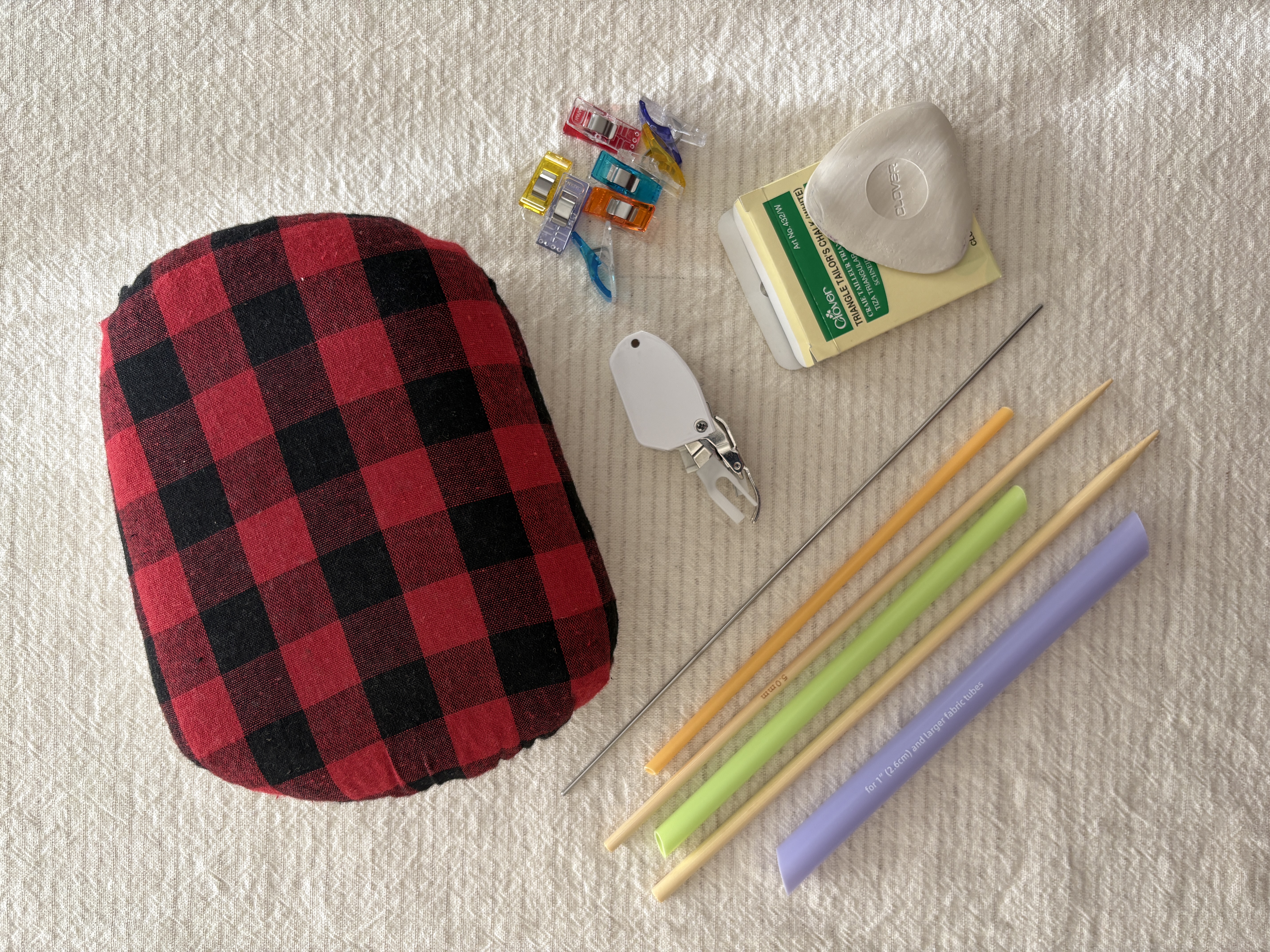
It’s an understatement to say that building my arsenal of sewing equipment over the past year and a half has been a grueling, trial-and-error-based process. When I first delved into sewing clothes, I went out and bought every recommended piece of gear on every list. Really, it doesn’t take much to get your foot in the door. As a new(er) sewist, here are the trinkets I pull out of my sewing kit for almost every project:
1) Magic clips. These puppies weren’t around when I first tried my hand at sewing in high school. I often got so frustrated with pins, I’d end up not using them at all, and then my garments would invariably end up wonky and crooked. But magic clips? They’re so much easier to use than pins AND they don’t draw blood! The only downside I’ve found is that sometimes they leave little dents in your fabric (not a big deal if you’re placing them in the seam allowances) and you can’t use them for internal sewing on things like patch pockets.
2) Tailor’s chalk triangle. I didn’t discover this one until recently and this is partially because I HATE the feeling of chalk on my hands. If my kids are using sidewalk chalk in the street, I nope my way out of that situation? And when it comes to rock climbing I accept my sweaty hands the way they are. I didn’t realize the side of the tailor’s triangle was polished nice and smooth, and it doesn’t actually get chalk on your hands. For a year I struggled with all sorts of marking apparatuses: chalk pencils that dull and break when they’re re-sharpened, liner pens that only work in one direction, and “disappearing” markers and pens that reappear under mysterious circumstances. Nowadays I use a chalk triangle for almost everything except those sneaky little drill marks.
3) Tailor’s ham. When you first start, they say you can use a rolled-up towel as a substitute, but this is a lie. There is NO substitute for a proper tailor’s ham. I use mine for darts, curved edges, sleeves, and any situation where I need to iron something and not accidentally press what's underneath. A simple ham is all you need to start, and then when you want to level up to fancytown you can invest in a sleeve roll and sleeve board.
4) Loop turner. Want to turn your straps and ties right side out in 5 seconds flat? So why are you still struggling trying to fit a safety pin through a tiny hole? Or wrestling with chopsticks? Loop turners are the answer. They come in a variety of sizes, allowing you to just get the heck on with your sewing project already.
5) Walking foot. Ok, I’ll admit I don’t use a walking foot on all my projects, but when you need one you need one! If you find yourself getting to the end of a longer seam and finding your pattern pieces are a little off-kilter, or repeatedly trying and failing to pattern match, a walking foot may be the answer. They are a little clunky and can be challenging to attach, but a walking foot will make your sewing that much tidier. This is, of course, if you don’t have the cash to invest in a differential feed sewing machine.
Honorable mentions: Bias tape maker: Kind of a pain in the butt…but still less of a pain in the butt than manually folding and ironing several meters of bias tape. Magnetic pin cushion: Especially handy if you have pets or children and are worried about safety. Rolled hem foot: They have a steep learning curve, but are great for hemming delicate skirts and dresses once you get the hang of them! Hump jumper: Great for bulky seams, especially if you’re sewing with heavy fabrics. Clapper: Ditto, but also helpful for fabrics that won’t cooperate when you’re trying to press them.
Hopefully this helps those of you who are starting out on your sewing journey!
- M.J.