
August 23, 2026
How Much Ease in a Block?
The Basic Pattern Set is meant to serve as a starting point for fitted woven garments, but what exactly does fitted mean? How much bust, waist, and hip ease should ideally be built into the block? This was a question I struggled with as I worked through my own blocks, especially when it came time to add the sleeves. Convention states that 2 – 3 inches of wearing ease is an ideal starting point. Of course, some of this is up to personal preference. My final block has 3 inches of ease in the bust and hips and 2 inches of ease in the waist. I also ended up with 3 inches of ease in the biceps—a decision made to allow greater range of movement (I’ll get to that in a moment).
My fitting journey went smoothly with the sleeveless bodice and skirt until it came time to add a fitted sleeve. Following Armstrong’s recommendations resulted in a sleeve that was bunched at the armscye (I find Armstrong’s recommendation that the sleeve cap be 1.5” longer than the armhole measurement to be excessive), and completely immobile. I could not even flex my elbow to a 90-degree angle, let alone raise my arms to the front or side.
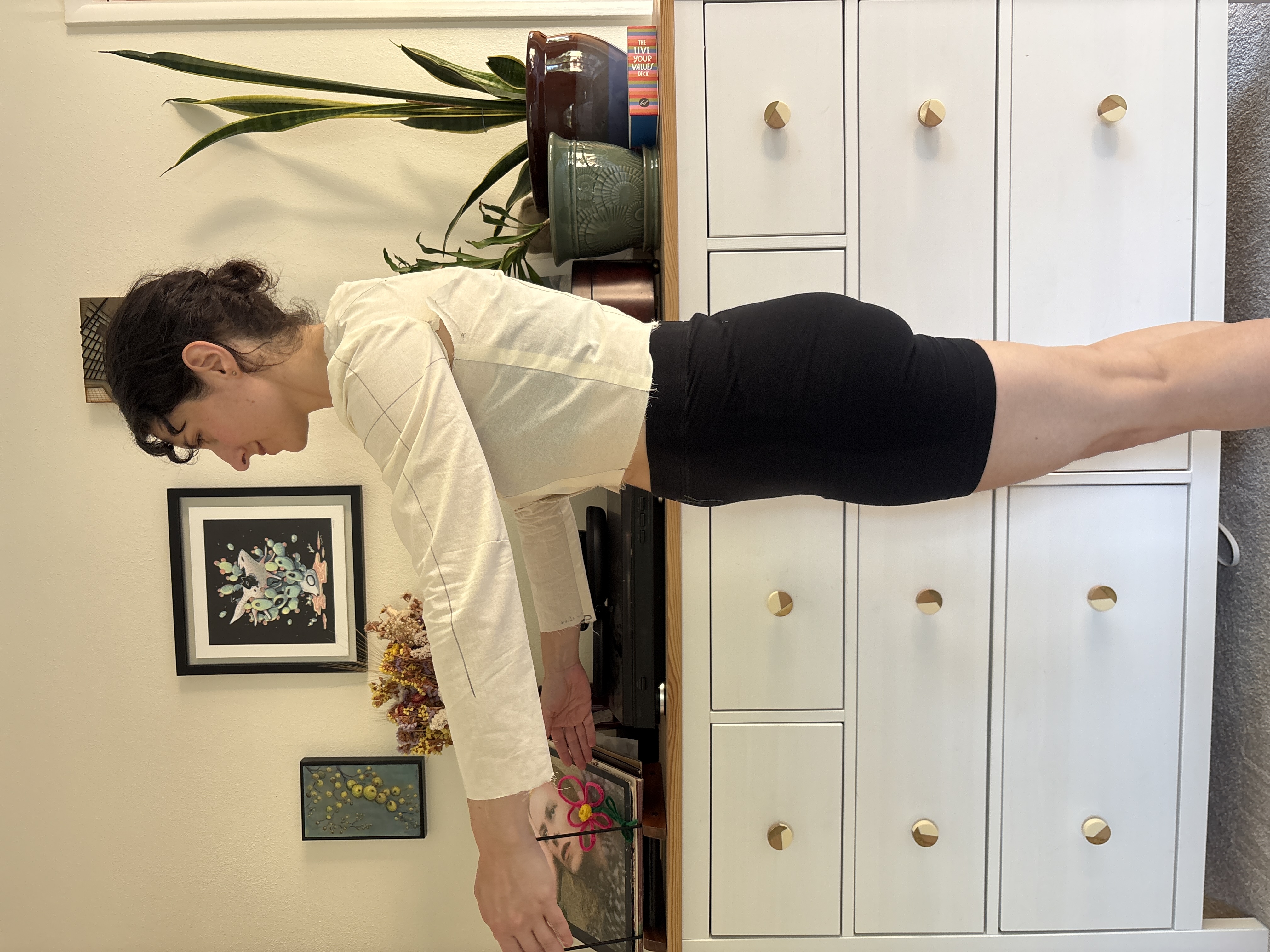
So then I started to ask: exactly how much should I be able to move in my block (and when can I give up my quest for perfection)?
The answer? A basic pattern set is not designed for movement. It’s designed to be static. You should be able to lift your arms around 90-degrees to the side and front without feeling as though your seams are about to rip, but a basic pattern block won’t tolerate lifting your arms over your head without significant adjustments to the sleeve cap and armscye (shortening the sleeve cap, for instance).
As for “perfection,” a good stopping point for making edits on your basic pattern set:
- The bust, waist, hip, and bicep have a preferable amount of wearing ease
- The bust apex, waistline, full hip, elbow dart, and other landmarks correspond to your body
- The center front and back hang vertically
- The side seams and shoulder seams sit in the appropriate location
- The darts point toward areas of fullness and produce the correct amount of shaping
- The neckline and armscyes sit against the body without gaping or binding
- The sleeve hangs balanced from the shoulder and permits functional movement (e.g., crossing the arms in front of the chest, lifting to 90-degrees)
- There are no persistent drag lines that indicate a length, width, or balance problem
If you’re getting to the point where you’re making micro-adjustments of 1/8” over and over again, you can consider your block complete for the time being! If you find yourself making the same tweaks over and over again once you start drafting new patterns from your block, you can always come back and revise it accordingly. Furthermore, almost every design you create from this block will change the way it drapes and fits! For example, widening an armhole might introduce gaping where there was none before. Adding an easier fitting sleeve with more mobility may require you to adjust the sleeve cap and armscye. A block’s job is to give you a known coordinate system so that when a derived pattern doesn’t fit, you know that the underlying bust level, shoulder position, waistline balance, etc. aren’t the problem.
- M.J.