August 30, 2026
Skills Insert 1: An Experiment with Facings
The first section of Skills Insert 1 is about facings and bias bindings. I have always, always hated facings, unless they can be secured with a decorative topstitch. Even then…I’m firmly a bias binding sort of girl. No matter how I secure them, my facings always seem to shift around and pop out of whatever opening they’re attached to.
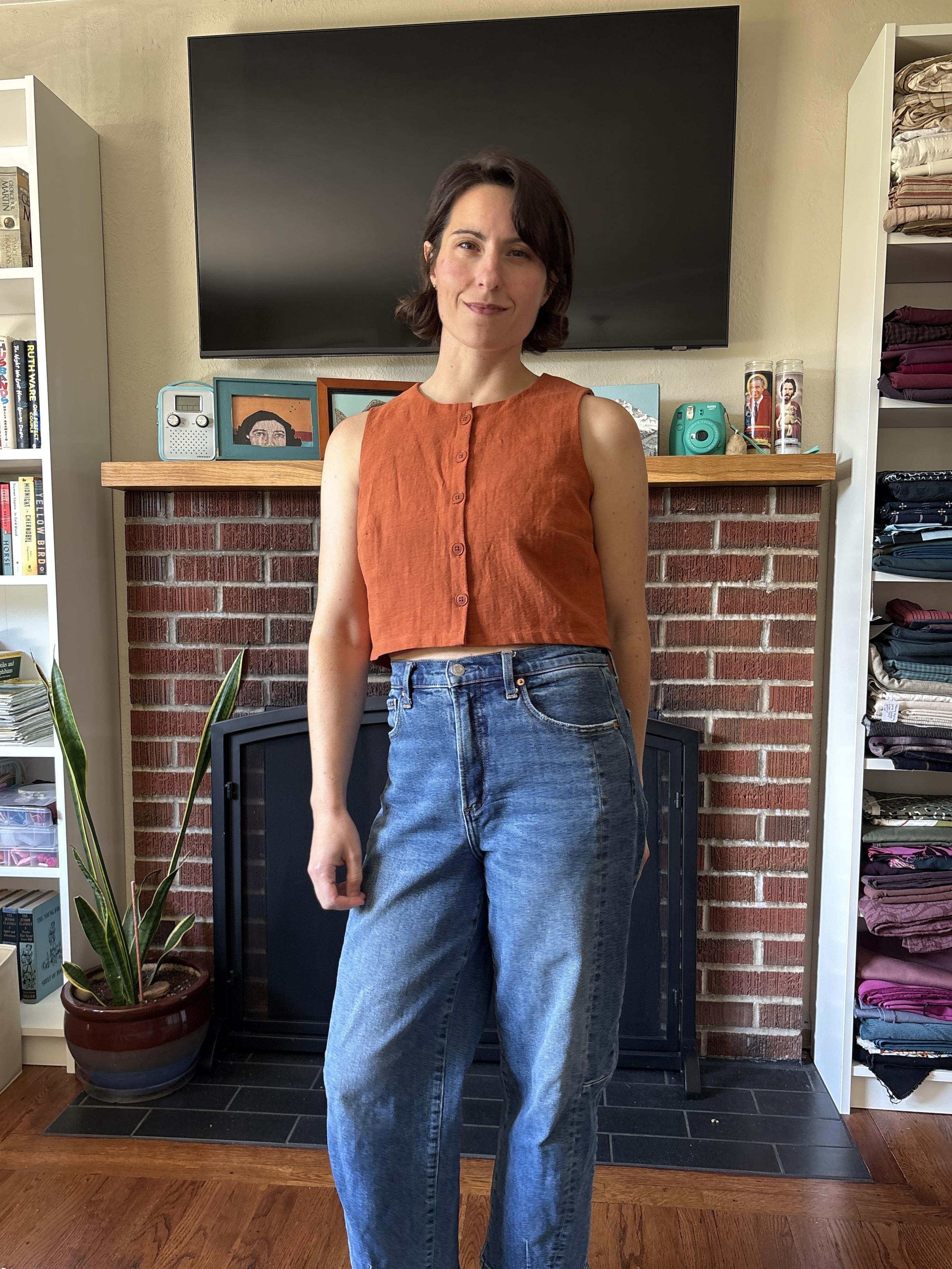
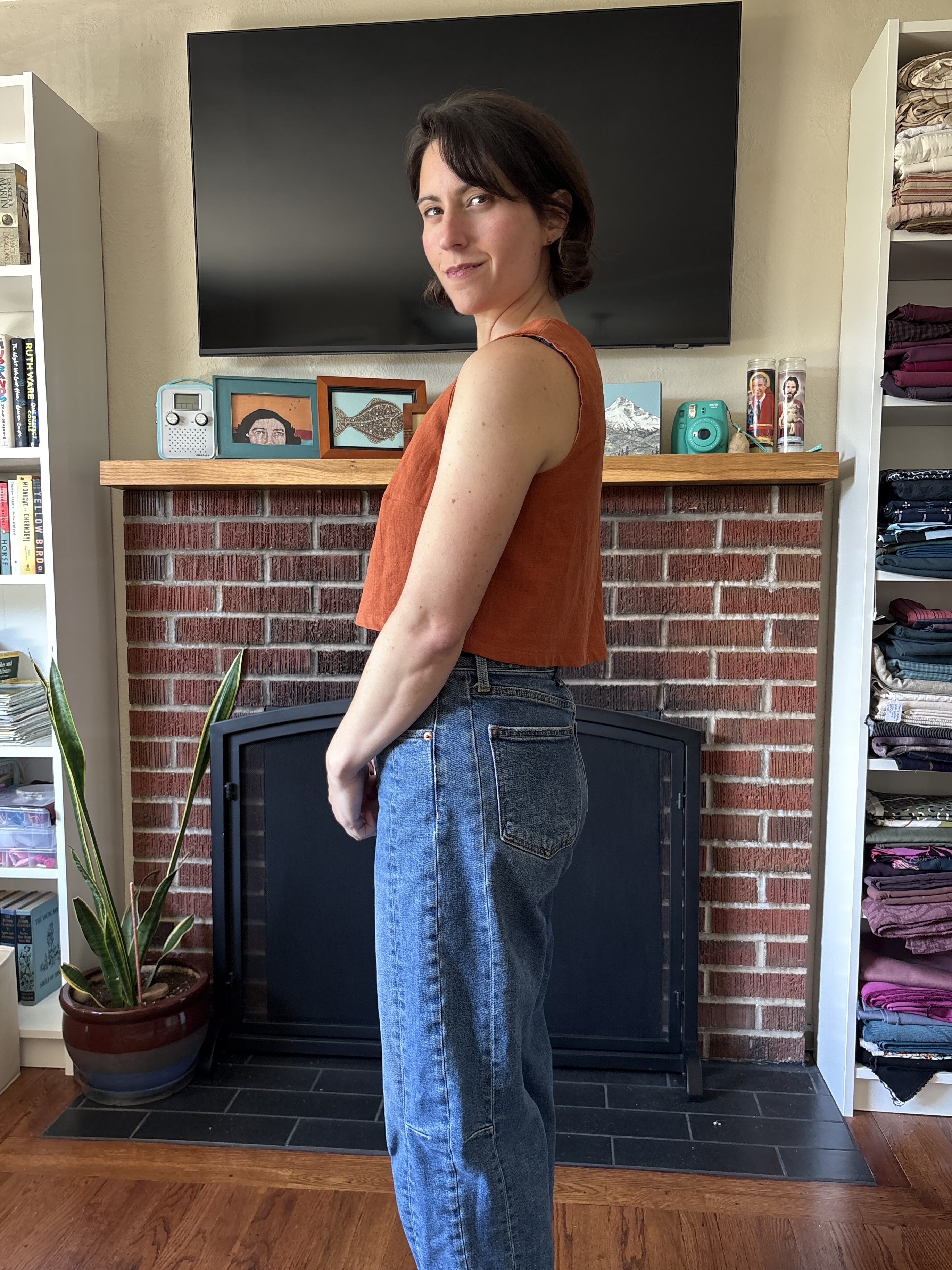
So, could I learn to love facings with a bit of practice? Spoiler: “love” is a little too strong of a word, but I do think I can learn how to incorporate them into my designs more effectively. Case-in-point, this little top is my first ever design drafted from my sleeveless bodice block, and it integrates an all-in-one facing for the neckline and armhole. Not bad, folks!
This little wearable muslin came to be because one of the “practice” exercises in the Facings section of SI-1 has you draft and sew an all-in-one facing. While I could have easily done this in muslin, I was already plotting ahead to the first Study Project in the insert: a sleeveless top with a button placket. I wanted to see how modifying the armhole and neckline changed the look of the bodice, and I’m quite pleased with the result.
What I did:
- Rotate the back shoulder dart to the waist, and convert the entire back waist dart to ease
- Rotate the front waist dart to the side seam
- Lengthen the top by 1”
- Lower the neckline by 1/8” in the back and 1 ½” in the front
- Bring the shoulder in at the armhole by 1 ½”
- Draft a 2” wide all-in-one facing (4” wide at the back neckline)
Even though I dug into the good fabric in my scrap pile, it’s still a muslin—I didn’t understitch or interface the facing, I used a black bobbin and serger thread, and the sewing is a little sloppy. She’s still cute, though! I thought the neckline and armhole shape was flattering on my figure, and the bust and shoulder area fits like a glove (proof my sleeveless basic block works!). The all-in-one facing, while it does still bunch up a little, isn’t completely annoying, and I appreciate the opportunities a facing offers for a secret little contrast fabric detail. In the next iteration for the actual Study Project, I’ll probably lengthen the bodice another inch, and find a way to get rid of some of the back ease that flares out, potentially by bringing the back bodice in at the side seams and re-truing.
I will also (probably) use a bias binding instead of a facing.
- M.J.